

|
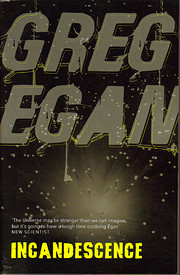
Loading... Incandescence (2008)by Greg Egan
  
No current Talk conversations about this book. One of the better Egan novels. Essentially the "science" hook here is an interesting way of explaining general and special relativity, which in real life are outside daily experience, but in the conditions of the book are quite relevant. Solid. The characters and plot were good too, although probably secondary to the exposition of science. (  ) )1   octal | Jan 1, 2021 | octal | Jan 1, 2021 |  This book definitely falls under a hardcore sub-category of Hard-SF. Great for fans of [b:Dragon's Egg|263466|Dragon's Egg|Robert L. Forward|https://images.gr-assets.com/books/1403166825s/263466.jpg|2530528], [b:Flux|100681|Flux (Xeelee Sequence, #3)|Stephen Baxter|https://images.gr-assets.com/books/1408926889s/100681.jpg|574446], [b:The Inverted World|142181|The Inverted World|Christopher Priest|https://images.gr-assets.com/books/1245646253s/142181.jpg|2226603], or [b:The Integral Trees / The Smoke Ring|218460|The Integral Trees / The Smoke Ring|Larry Niven|https://images.gr-assets.com/books/1392169628s/218460.jpg|211515] where we get a significant amount of time from the PoV's of the aliens as they discover the science and topography of their world. I love these kinds of books for exactly that reason. Great science, fascinating discoveries, and truly ODD topographies. They're mystery novels for physical sciences. :) BUT. For the same reasons, I often get angry at the tediousness of them. The dragging pace and the often boring characters. *sigh* But it's not a reason to throw out the novels altogether. There's a real rich atmosphere going on in them. Incandescence arrives at a lost, genetically enhanced alien species that forced itself into a kind of survival in the tight liveable bands surrounding a neutron star. We're forced to discover this the hard way, along with the aliens, from first principles. If you love math and topography and discovery, I TOTALLY recommend this novel. For everyone else more interested in characters... look elsewhere. :) (  ) bradleyhorner | Jun 1, 2020 | ) bradleyhorner | Jun 1, 2020 | I know what the twist is. I get what the author was going for. I even read supplemental material on the author's blog. It seems safe to say I have experienced this book. No need to waste more time on the minutia of Splinter physics. I love slogging through science text-book-y passages in SF novels even though I don't always (usually (ever)) understand it. But this book has taught me that I have a limit, and that limit is realizing at page 100 that the only thing I know about Rakesh's personality or motivations is that he's bored. I need more than that from a story in order to get invested in untangling the science for myself. (  ) lightkensei | May 17, 2020 | ) lightkensei | May 17, 2020 | Alright, I'm gonna go ahead and critique this book’s critics. It's perfectly understandable that folks are finding it a difficult read. I'm sure there are undergraduate text books that are more accessible. However, I challenge the idea that this is a failing. I'm quite sure that Egan didn't write this expecting its appeal to be especially broad. He's aware he's writing for a niche audience. That in mind, he's untethered. He can unleash his arsenal with the assurance that anyone who's already reading is likely a hardened veteran who knew the score going in. If was writing for the Harry Potter crowd, I'd agree that he spends too much time on minutia. This, along with some of his other works, is something to read, but not necessarily to tell all your friends to read. My bias is that I loved the book, cover to cover. Its protagonists are post-biological life-forms. How cool is that? He did an admirable job distinguishing them from modern humanity in a more or less plausible way. Kinda breaks the Kardashev scale, too. It's no just a space opera, it's a transhumanist's wet-dream. Somewhere out there in the vastness of space life exists, it will have evolved as we have on Earth. I don't think it's much of a reach to assume that. Everywhere we look in our solar system we're finding water for instance, it's not the Earth exclusive asset some presume. Life IS out there. Much if it could be far more advanced than we are, thus when something doesn't fit any naturally known causes I don't see the harm in beginning to consider that something artificial may be in play that can explain it. Sure it most likely will be natural and just a new phenomenon that we've not seen before. But alien civilisations are not in the crazy spectrum of possibility. It’s only that Greg Egan fictionalises this like no other by using “plain” and “boring” Physics. I love it. ( ) antao | May 5, 2019 | A socratic dialogue on physics written with made-up alien words, extremely light on diagrams which could help illuminate the concepts being presented. I wasn't invested enough to build a mental model of the dozen above/left/past/around/within locational words used on every page. ( ) sarcher | Mar 28, 2019 |
 Although occasionally uneven and frustrating, the book is a terrifically interesting thought experiment that will appeal to anyone who likes a strong, intelligent science mystery. And Egan's civilization-building is simply breathtaking. His deft creation of an alien civilization of tiny insects living in orbit around a neutron star at the center of the galaxy provides such an appealing narrative throughline that you won't be able to put Incandescence down until its extremely weird conclusion.
"The Amalgam spans the nearly entire galaxy, and is composed of innumerable beings from a wild variety of races, some human or near it, some entirely other. The one place that they cannot go is the bulge, the bright, hot center of the galaxy. There dwell the Aloof, who for millions of years have deflected any and all attempts to communicate with or visit them. So when Rakesh is offered an opportunity to travel within their sphere, in search of a lost race, he cannot turn it down. Roi is a member of that lost race, which is not only lost to the Amalgam, but lost to itself. In their world, there is but toil, and history and science are luxuries that they can ill afford. When she meets Zak, the male who will become her teacher and mentor, everything starts to change. Their strange world is under threat, and it will take an unprecedented flowering of science to save it. Rakesh's journey will take him across millennia and light years. Roi's will take her across vistas of learning and discovery just as vast"--Dust jacket. No library descriptions found. |
 Google Books — Loading... Google Books — Loading...Popular coversRatingAverage: (3.56) (3.56)
Is this you?Become a LibraryThing Author. |
||||||||||||||||||||||||||||||||||||||||||||||||||||||||||||||||||||||||||||||||||||||||||||||||||||||||||||||||||||||||||





 Wikipedia in English (1)


 5
5