

|
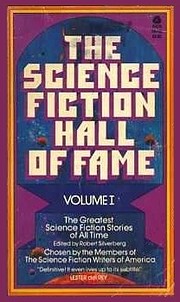
Loading... The Science Fiction Hall of Fame, Volume One: The Greatest Science Fiction… (1970)by Robert Silverberg (Editor)
   No current Talk conversations about this book. This is one of the best collections of short sci fi stories ever. Maybe 3 of the 26 weren’t excellent. (  ) ) octal | Jan 1, 2021 | octal | Jan 1, 2021 |  This series is in three volumes, cunningly called “Volume 1″, “Volume 2A” and “Volume 2B”. (The second volume was split into two physical book for publication.) That makes this article the first of a series of… I’ll play it save and say “a bunch”. It seems appropriate to split up this review in particular. In 1965, the Science Fiction Writers of America started giving out the Nebula Awards. They published this anthology and its companion volume(s) by way of recognizing pre-1965 work that the membership thought was exceptional. I read this book and its siblings in the seventies; the stories seem better in some ways, particularly the more sophisticated prose. A few stories haven’t ages all that well. Story-by-story reviews (part 1) are here, I'm currently working on part 2. ( ) neilneil | Dec 7, 2020 | "Twilight," by John W. Campbell (1934): 6.75 - interesting, for an early sci-fi, to even feel like it needs this narrative conceit of the modern day hitchhiker and relaying the story, when this kind of Olaf-Stapleton-like, epic, world-surveying voice is common. Therefore, the former is clearly pointless, maybe even to Campbell, who really has no idea what to do with it (or how to end it). But the big-picture, Götterdämmerung human narrative is otherwise moderately interesting, and not just because it prefigured Bradbury in its robots and/or machines continuing human-designed work long after humans or the need to exist. "The Roads Must Roll," by Robert Heinlein (1940): 9 - Here it is, CS Lewis, you Ewiggestriger, watch and learn. This is how you do conservative sf. The piece: revolutionary movement, brewed up within labor circles, try and take over an Essential Industry (the sfnal element here, a massive highway system [decade before Eisenhower] that is, however, car-less and instead simply propelling humans themselves), only to be put down by a very competent engineer cum bureaucrat who restores order. For what could be quite dull material (much is literally about rotors and the mechanics of the roads themselves), the pacing is expert. Against my better judgment, I was fairly genuinely thrust along after the initial accident and following Gaines piecing together what had happened. I’ve not read much Heinlein, and when I do see him mentioned, it is often in the context of his prose, or his writerliness, esp. in relation to contemporaries (and this is much earlier than much of what I’ve been reading recently, without showing it). And I wouldn’t say it approaches beauty, but it seems a perfect, genre-specific blending of narritivization and smooth tech-speak, a twosome I’ve seen writers have mostly felicity at one or the other. I see why, for a certain type of sf reader, this is a model worth aping. The conservative is there though, and kind of to-be-expected with this type of man at this type of time, to be honest. But, more than the social conservatism of many contemporary sf reactionaries, it’s the conservatism of the engineer—the conservatism of those who wouldn’t see it as such. As a character says, in sum, “men fail; machines don’t.” A golden age maxim if I’ve ever heard one. 1  Ebenmaessiger | Oct 6, 2019 | Ebenmaessiger | Oct 6, 2019 | This review is written with a GPL 4.0 license and the rights contained therein shall supersede all TOS by any and all websites in regards to copying and sharing without proper authorization and permissions. Crossposted at WordPress, Blogspot & Librarything by Bookstooge’s Exalted Permission Title: The Science Fiction Hall of Fame, Vol. 1: 1929-1964 Series: The Science Fiction Hall of Fame #1 Editor: Robert Silverberg Rating: 5 of 5 Stars Genre: Science Fiction Pages: 576 Format: Trade paperback Synopsis: A collection of short stories voted by members of the Science Fiction Authors Guild (or something or other like that) as the best of. A popularity contest of stories from the 30's to the 60's. No author had more than one story and the book was presented chronologically, so we as the readers could see how things progressed storywise in 30 years. My Thoughts: Danielle from Books, Vertigo and Tea reviewed this recently and brought it to my attention. What a fantastic read. First off, this was originally published back in 1970, I believe. It was released again in 2005 and then just released digitally in 2018. Obviously not a new book. I read this at lunch beginning sometime in March and just finished it this past week. Short stories really lend themselves to no pressure reading and going at a slow pace. Sometimes you need that in a busy, hectic book life like mine. I had read over ½ of these 26 stories, as growing up in the 80's and addicted to SF meant I was familiar with almost all of these authors, even if just by name. This was good stuff! If you've never read Vintage SF, this is a good place to start. Even if you don't like every story (and I didn't like every one either), you'll get the flavor of what those years produced and if an author strikes your fancy, you can then go on and investigate on your own. In many ways, I think that Science Fiction shines through the short story medium. Ideas are presented and there is no extraneous fluff or junk to ruin it. And if your imagination isn't up to snuff to get you excited about ideas, then you probably shouldn't be reading SF in the first place. I bought this used in trade paperback through Amazon but I think the stories are good enough that I'm going to have to put the hardcover on my wishlist. In terms of Short Story Collections, this falls squarely between Asimov's Complete Stories Vol 1 and Asimov's Complete Stories Vol 2. I do plan on buying, in used trade paperback again, Volumes 2 & 3, which are the best novella's of that time period. Hopefully they are as good as these stories. ★★★★★ ( )1 BookstoogeLT | May 14, 2018 | What can I say. Well chosen. There are a couple that I would have replaced with other stories but most were true gems. I have forgotten how good the John W Campbell and the Lester del Rey stories were. A surprise was "The Weapon Shop" by A. E. van Vogt. I did not know it was a short story before he turned it into a novel. It was stronger in the short version. These early stories were very good. ( ) ikeman100 | Apr 29, 2018 | no reviews | add a review
The book you now hold contains twenty-six of the greatest science fiction stories ever written. Robert Heinlein in "The Roads Must Roll" describes an industrial civilization of the future caught up in the deadly flaws of its own complexity. "Country of the Kind," by Damon Knight, is a frightening portrayal of biological mutation. "Nightfall," by Isaac Asimov, one of the greatest stories in the science fiction field, imagines a planet where the sun sets only once every millennium and is a chilling study in mass psychology. No library descriptions found. 
|
 Google Books — Loading... Google Books — Loading...Popular coversRatingAverage: (4.28) (4.28)
Is this you?Become a LibraryThing Author. |
|||||||||||||||||||||||||||||||||||||||||||||||||||||||||||||||||||||||||||||||||||||||||||||||||||||||||||||||||||||||||||||||




 Wikipedia in English (3)


 1
1