

|
Loading... Emphyrio (1969)by Jack Vance
   No current Talk conversations about this book. Orwellian tale describing the ultimate Socialist society where the world is owned by private utilities and everyone is on the dole, paid minimum wage for producing artifacts for sale to other worlds. The only exceptions are "noncups" a barely tolerated group living by their wits and doing the only "real" work, mainly pimping and black marketeering. There is however a twist that takes the story in unexpected directions. (  ) ) SFF1928-1973 | Dec 3, 2019 | SFF1928-1973 | Dec 3, 2019 |  Gaiman said this was the Vance novel he liked best. There's hints of Star Wars coming from here ( including ' Star Wars ' ... ) and a hint of H2HG in ' Rolver's Directory ' ~ (  ) Baku-X | Jan 10, 2017 | ) Baku-X | Jan 10, 2017 | Wow. That was amazing. Both my niece and I were blown away by [Vance]'s [[Emphyrio]]. It gives the book another whole level of amazingness to read it aloud, and in two days. (Or was that three?) Yes, we could quibble about this and that in the book, but I am not going to. I am glad I didn't read the cover blurb, or any reviews, or remind myself of what I knew of Vance from earlier acquaintance by browsing the Wikipedia entry. I had no idea what to expect and I was therefore not misled or disappointed. A great reminder of what science fiction is capable of. Read. Enjoy. Pass it on. http://www.bookfinder.com/search/?author=&title=emphyrio&lang=en&isb... (  ) thesmellofbooks | Dec 22, 2016 | ) thesmellofbooks | Dec 22, 2016 | Far in the future, young Ghyl rebels against the system that would have him carve wood his whole life, without hope of luxury or travel. He is raised by his thoughtful, brave, but slightly unworldly father. His father teaches him to read archaic script, including the ancient covenant of their world and the legend of Emphyrio. Inspired, Ghyl first tries to run for mayor, I read this in the same spirit as a child eating their vegetables. I've never yet enjoyed "classic" sf (a category in which I throw Asimov, Clarke, Heinlein, etc), but I feel like I ought to read it in order to properly understand and appreciate the genre. The Worlds Without End Grand Masters Challenge provided the prod to do so. It was better than much of the trashy fantasy I read, but not by much. Although ostensibly sf, the tech obeys no physical laws--Ghyl never worries about running out of spaceship fuel, nor is there any explanation for how any of the tech works, and the alien construct creatures make no logical sense. The childhood of Ghyl is described in interminable detail, to no point I could discern. The dialog is stilted and unbelievable, like a mix of Dostoyevsky-translated-into-English and Socratic dialogs. Ghyl has the same vocabulary and thoughts as a nine-year-old as he does as an adult. He is a bit of a cypher; the other characters have even less personality. And the plot just doesn't make sense. BUT. The female characters are not treated any differently than the male by the author (although they do still follow 20th century roles, and are only present in the story as love-interests). Some effort was clearly put into the world-building; certain details are very vivid. To my mind, this book would have been much better if it had been either been much shorter or a bit longer. As a novel, the pacing is very ragged: we spend chapter upon chapter watching Ghyl grow up, and then no time at all I don't intend to read any more by Vance--but I don't regret reading this. It's got at least a few ideas to it, and the descriptive text (if not the dialog) are good. ( ) wealhtheowwylfing | Feb 29, 2016 | Quite good, end is a bit abrupt. (  ) questbird | Oct 7, 2013 | ) questbird | Oct 7, 2013 | no reviews | add a review
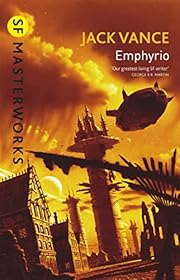
Far in the future, the craftsmen of the distant planet Halma create goods which are the wonder of the galaxy. But they know little of this. Their society is harshly regimented, its religion austere and unforgiving, and primitive - to maintain standards, even the most basic use of automation is punishable by death. When Amiante, a wood-carver, is executed for processing old documents with a camera, his son Ghyl rebels, and decides to bring down the system. To do so, he must first interpret the story of Emphyrio, an ancient hero of Halman legend. No library descriptions found. |
 Google Books — Loading... Google Books — Loading...Popular coversRatingAverage: (3.84)
GenreThingIs this you?Become a LibraryThing Author. |
|||||||||||||||||||||||||||||||||||||||||||||||||||||||||||||||||||||||||||||||||||||||||||||||||||||||||||||||||||||||



 Wikipedia in English (1)


 8
8